Pricing
Applicable roles: Admin user, Member user Last updated: 2026-08-06
This page explains credit-based billing, group pricing, charge breakdowns, and where to look up prices.
1. Billing Overview
Top up -> Call models -> Credits deducted based on actual usage.
- No monthly fees, no minimum spend -- you only pay for what you use.
- RMB converts to credits at a 1:1 ratio (1 RMB = 1 credit). Credits are deducted per call based on usage.
- Each model has an official credit price. The group (service tier) you select applies a discount on top of that price, and you are charged at the discounted rate.
2. What Are Credits
Credits are the platform's unified billing and balance unit. The relationship with RMB is straightforward:
1 RMB = 1 credit.
If you top up 100 RMB, your account holds 100 credits. Each API call deducts the corresponding credits, and the remainder is your available balance. Log in to the console and check the dashboard home page to see your current balance.
"Credits" and "balance" are essentially the same thing: at top-up time it is called "balance"; at billing time it deducts "credits." The values are identical.
Different models may use different pricing dimensions. The platform converts everything into credits. Usage records and the call guide display values in credits; the model plaza shows official reference prices -- refer to the unit labels on the page.
3. How Many Credits Does a Single Model Call Cost
Four Billing Dimensions
A single call typically consists of the following components (not all models include every one):
| Dimension | What It Is | Pricing Characteristics |
|---|---|---|
| Input | The content you send to the model | Base price |
| Output | The content the model returns | Usually differs from the input price; refer to the console |
| Cache write | Storing repeated content into cache for the first time | Slightly higher than input; available in "5-minute" and "1-hour" TTL tiers |
| Cache read | Subsequent cache hits that reuse cached content | Cheapest |
Additional dimensions such as image input/output, audio, video, or per-request pricing may also apply. Refer to the charge breakdown for details.
Not every call includes all four items: models that do not support caching only have input and output; if a call does not write to or hit cache, the corresponding items are 0.
Basic Formula (All Calculated in Credits)
Charge per call (credits) = Input + Output + Cache write + Cache read + Other enabled dimensions

For token-based billing, each item = Tokens in that dimension / 1,000,000 x Credit unit price for that dimension x Group discount
Models billed per request or per image do not use the token formula above. Refer to the charge breakdown for the specific billing method.
Input and output are priced separately. The two cache items only apply when the model supports caching and a write or hit actually occurred during the call.
Model Credit Price + Group Discount
Each model has a set of official credit prices (one each for input / output / cache). The group you select multiplies the official price by a discount factor:
Your actual unit price = Official credit price x Group discountThe discount factor is a number between 0 and 1. A value of 1 means full price (no discount); the smaller the number, the cheaper:
- Discount 1.0 = full price
- Discount 0.7 = approximately 30% off
- Discount 0.571 = approximately 43% off (the lower, the more you save)
Note: Earlier versions used a "multiplier xN" concept. This has been unified to "discount factor" -- there is no longer a markup multiplier. You do not need to calculate charges manually. The price shown in the call guide is your group's final discounted price -- just refer to that number.
Cache Pricing
Whether cache write and cache read are supported, along with their specific unit prices, depends on the model and group. Refer to the model plaza and charge breakdown for accurate figures -- do not estimate using fixed ratios.
Long-Context Billing
Some models may apply different billing rules based on context length. Whether long-context tiers exist, along with their thresholds and unit prices, is subject to the current description in the model plaza.
A Simple Example (Illustrative)
Suppose a model under your selected group charges: 20 credits per million tokens for input, 100 credits per million tokens for output (illustrative numbers -- refer to the model plaza for actual prices). You send 800 tokens and the model returns 1,200 tokens:
Input  = 800 / 1,000,000 x 20  = 0.016 credits
Output = 1,200 / 1,000,000 x 100 = 0.12 credits

Total = 0.136 credits ≈ 0.14 RMB
For an example that includes the main billing dimensions, see Pricing Example: DeepSeek V4 Flash.
4. Charge Breakdown: See How Every Charge Is Calculated
In "Usage Records," hover over the "Charge" column of any record to see a charge breakdown popup for that call:
- Per-dimension credits charged (input / output / cache read / cache write -- how much each)
- Unit price for each dimension (credits per million tokens)
- The discount applied (e.g., "approx. 43% off"); not shown if no discount is configured
- The crossed-out standard total (full-price credits without discount) and the actual total charge
The discount is frozen at billing time. Even if the platform adjusts prices later, the discount and original price in this historical record remain unchanged, making it easy for you to reconcile.
5. What Are Groups
A group can be understood as a "service tier." The platform offers the same model through different groups, each with different pricing and stability characteristics. Think of it like train travel: economy and first class go to the same destination, but comfort and price differ.
| Tier | Discount Characteristics | Best For |
|---|---|---|
| Economy | Largest discount, cheapest; may have occasional fluctuations | Personal learning, test/dev, low stability requirements |
| Standard | Moderate discount, good stability | Day-to-day business use |
| Premium | Small discount (close to full price), most stable upstream accounts | Production environments, strict availability requirements |
Notes:
- Group names and specific prices are subject to what the console's "Model Plaza" or "Call Guide" actually displays. The table above is illustrative only.
- When you create an API Key, you bind it to a group. All subsequent calls made with that key are billed at that group's prices.
- Choose Economy for low cost, Premium for stability -- the decision is yours.
- All listed models use the unified group discount mechanism. Refer to the model plaza for specific standard prices.
Group Discount Labels
When a discount is configured for a group, a discount label appears next to the group name. This label now shows alongside the group in three places, so you can see the cost before making your choice:
- The group dropdown when creating an API Key
- The "Group" column in the key list
- The inline group-switching dropdown panel in the list
Groups without a configured discount do not display a discount label.
Groups Also Have a "Billing Type"
In addition to discounts, groups are distinguished by billing type: Balance (pay-as-you-go, deducts from credit balance) and Subscription Quota (subscription-based, deducts from subscription seat quota). The group dropdown when creating a key indicates this as well. The two tracks do not deduct from each other. For details, see Subscription Management and Member Allocation.
6. Where to Check the Latest Prices
| What You Want to Know | Where to Look |
|---|---|
| Credit unit price for a model across groups | Console -> Call Guide |
| Models available on the platform and official reference prices | Console -> Model Plaza |
| Top up and purchase credits | Console -> Redeem / Top Up Subscription |
| Historical charge details (including the "Charge Breakdown" popup) | Console -> Usage Records |
| Current balance | Console -> Dashboard home page |
Model prices may change due to provider price adjustments or platform policy updates. Always refer to the actual display in the console.
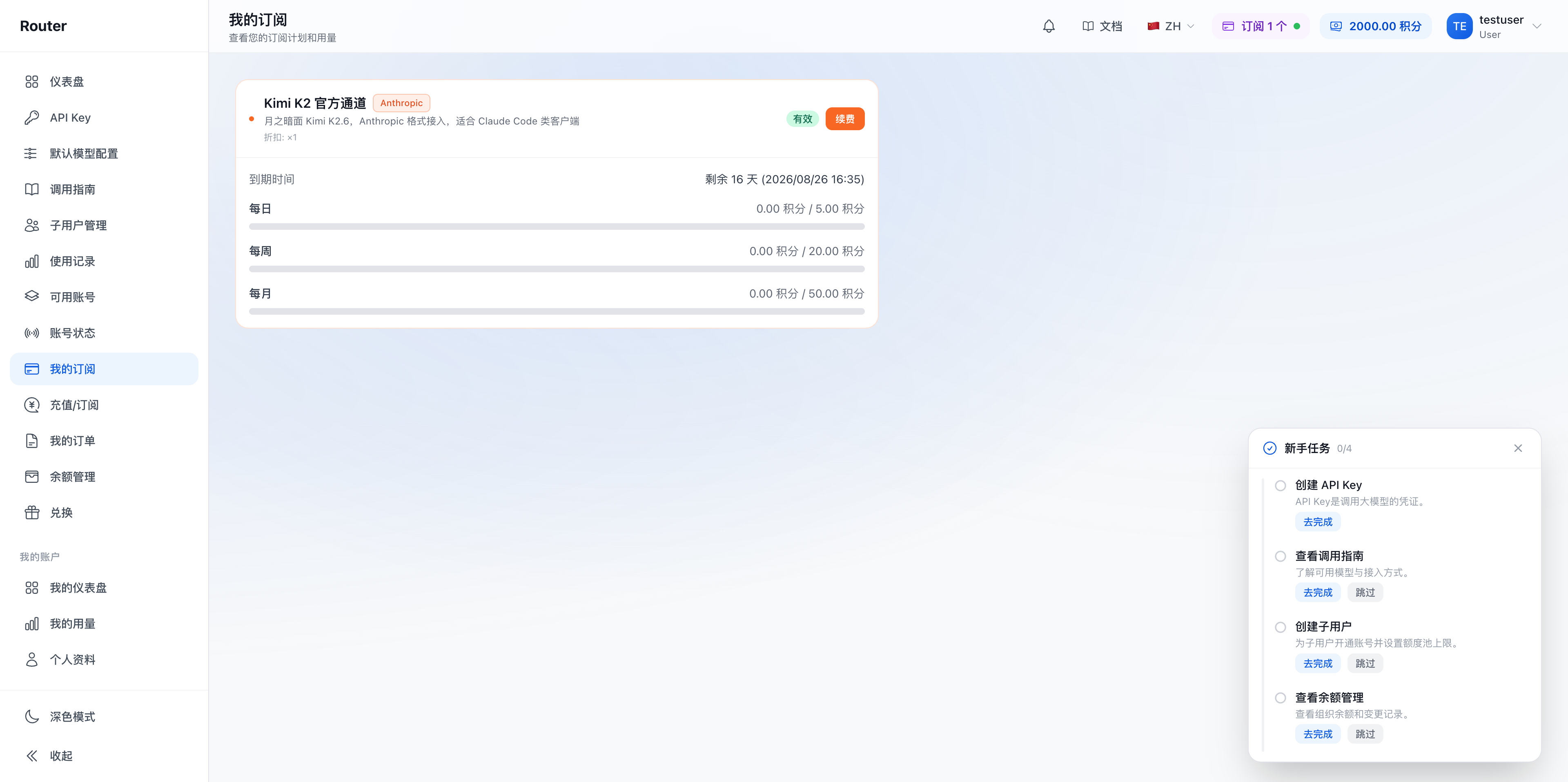
My Subscriptions page:
7. FAQ
Q: How long can 100 RMB last?
A: It depends on which models you use and how much you use them. As a rough estimate using a mid-priced model for a typical conversation (about 800 input + 1,200 output tokens), a single call costs approximately 0.1 credits. With 100 credits, you can have over a thousand such simple conversations. Long document processing or large-scale code generation costs significantly more, reducing the number of calls accordingly. For light daily use, 100 RMB can last a long time.
Q: What is the difference between credits and balance?
A: There is no difference -- they are two names for the same thing. At top-up time it displays as "balance"; at billing time it deducts "credits." 1 credit = 1 RMB, and the values are identical.
Q: What are tokens?
A: Tokens are the basic units a model uses to process text. As a rough guide: 1 Chinese character is approximately 1-2 tokens, and 1 English word is approximately 1 token. Tokens are counted automatically by the platform and displayed in usage records.
Q: Why does the same model have different prices in different groups?
A: Because different groups use different upstream accounts with different discount levels. Groups with discounts close to full price typically have more stable upstream accounts and better service guarantees, hence the higher cost. Groups with larger discounts are cheaper but may have slightly lower stability. Choose the one that fits your business scenario.
Q: What is the discount?
A: The discount is the factor each group applies on top of the model's official credit price. It is a coefficient between 0 and 1: 1 = full price, and the smaller the number, the cheaper (e.g., 0.571 = approximately 43% off). In practice, you can simply check the discounted price in the call guide -- the price displayed there is already the final discounted price. (The earlier "multiplier xN" terminology has been deprecated.)
Q: What are "long-context tiers"? Will my costs suddenly increase?
A: Some models may apply different billing rules based on context length. Refer to the model plaza and charge breakdown for specific thresholds and prices.
Q: What is caching? How much can it save?
A: Some models support prompt caching -- refer to the model plaza for specifics. If your calls include large blocks of repeated context (such as a fixed system prompt), the model automatically caches that portion. When the cache is hit, those tokens are billed at a rate far below the standard input price. The more repeated calls you make, the more you save. For details, see Pricing Example.
Q: Is there a free quota after registration?
A: Whether free credits are granted depends on current promotional campaigns. If you used a promo code or redemption code during registration, the corresponding credits are added to your account directly. Refer to the registration page for details.
Q: Can I get a refund after topping up?
A: If you need a refund, please contact platform support to discuss.